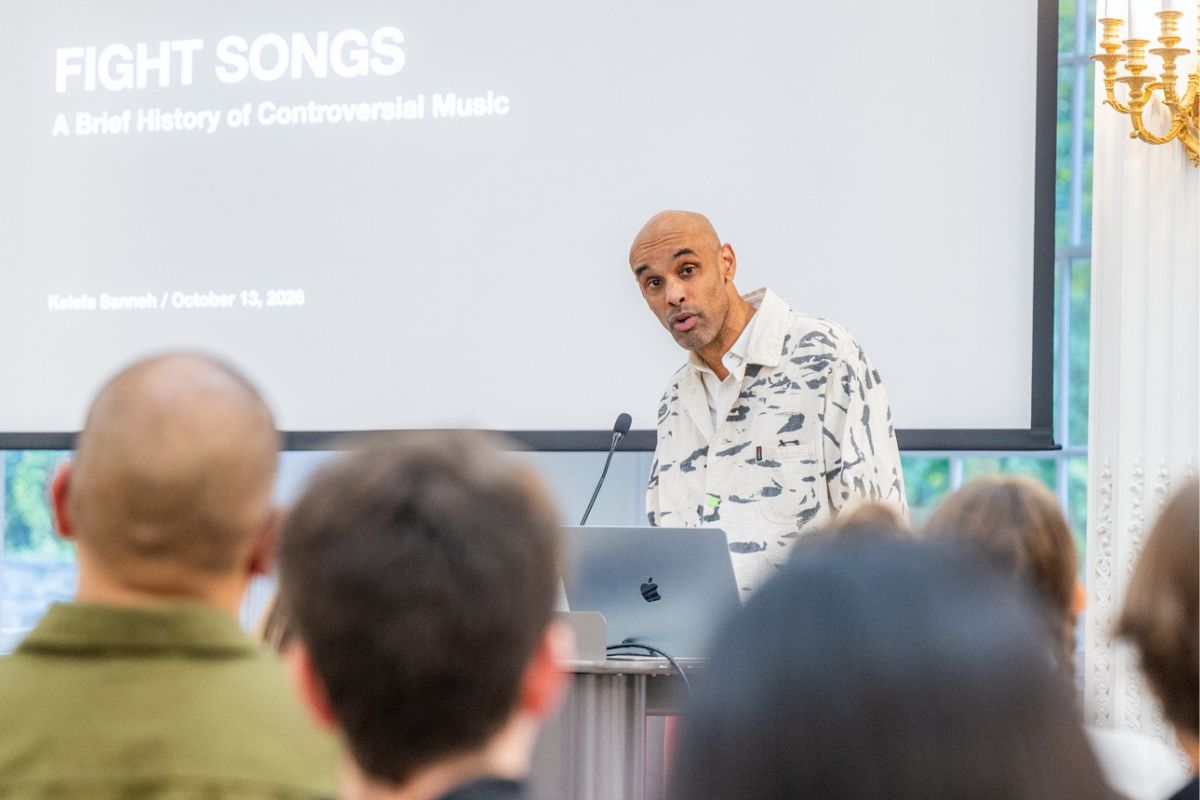
In an already memorable fall semester, two days during a very busy week at the Cogut stand out for me. On October 13, Kelefa Sanneh, staff writer at The New Yorker and author of the book Major Labels: A History of Popular Music in Seven Genres (Penguin Books, 2021), gave the year’s first Flynn Lecture. The next day, Gina Pérez (Comparative American Studies | Oberlin College) and I recorded the first episode of season 2 of our podcast, “The Confluence,” which explores the origins and evolution of Ethnic Studies, with the fiction writer and 2023 MacArthur Fellow Manuel Muñoz (English | Arizona State University) and the literary critic Ralph E. Rodriguez (American Studies, English). I learned a great deal and found the two conversations speaking to each other in ways I didn’t expect.
Sanneh’s lecture, “Fight Songs: A Brief History of Controversial Pop Music,” was a defense of something we usually try to avoid: disagreement. “Learning to love music and learning to hate music [are] part of the same process,” he said, before offering examples of music that have provoked controversy. In discussing country music, long imagined as white, he traced its embrace of hip-hop and the backlash that followed. Even listeners who say they don’t care about genre, he explained, have firm rules about what counts as music. Musicians make the music, Sanneh argued, but listeners decide what it means, and “most of us are defined as much by what we reject as what we accept.” Genre, he said during the Q&A, is another word for community or tradition, and there’s nothing to rebel against without one. Sanneh’s talk combined a scholar’s depth with a music nerd’s pure enthusiasm. He described himself as “a go-between,” a child of academics who learned at the scholarly journal Transition to carry debates from inside the academy to general readers, and whose test for every sentence is whether people will want to read the next one.
The next day’s conversation, the first of a two-part series on Latinx studies, focused on literature. Manuel and Ralph’s friendship took root inside the academy, but through a field that began as a challenge to it. When Manuel arrived at Cornell for his MFA after training in Renaissance drama at Harvard, his mentor, the novelist Helena María Viramontes, handed him a list of Chicano books he had never read and asked, “What did they do to you?” She urged him to know who came before him and to “fill in the blank space.” She also told Ralph, after reading an early essay of his, to “write this so people can read it.” Ralph has written about and taught Manuel’s stories for years, and Manuel described being read seriously by a critic as “empowering and enlightening.” Both have built distinguished careers and value much about academic life. Yet Manuel spoke with real ambivalence: his teachers urged him to protect his time for writing, and he came to teaching because “the opportunities came looking for [him],” and because students needed to see faces like theirs at the front of the classroom.
Different as they were, both conversations showed what becomes possible when you know a tradition well enough to push against it, and when the university is a place that makes meaningful work possible rather than being an end in itself. They also both reminded me how enriching the humanities are in my own life: they make me look more closely at things, hear a familiar song differently, and see the quiet tragedy in the most ordinary stories of the most overlooked lives. Ralph called it “curiosity and wonder,” and I am grateful for those two days that left me with plenty of each.