Cogut Institute for the Humanities

2025–26 Annual Report

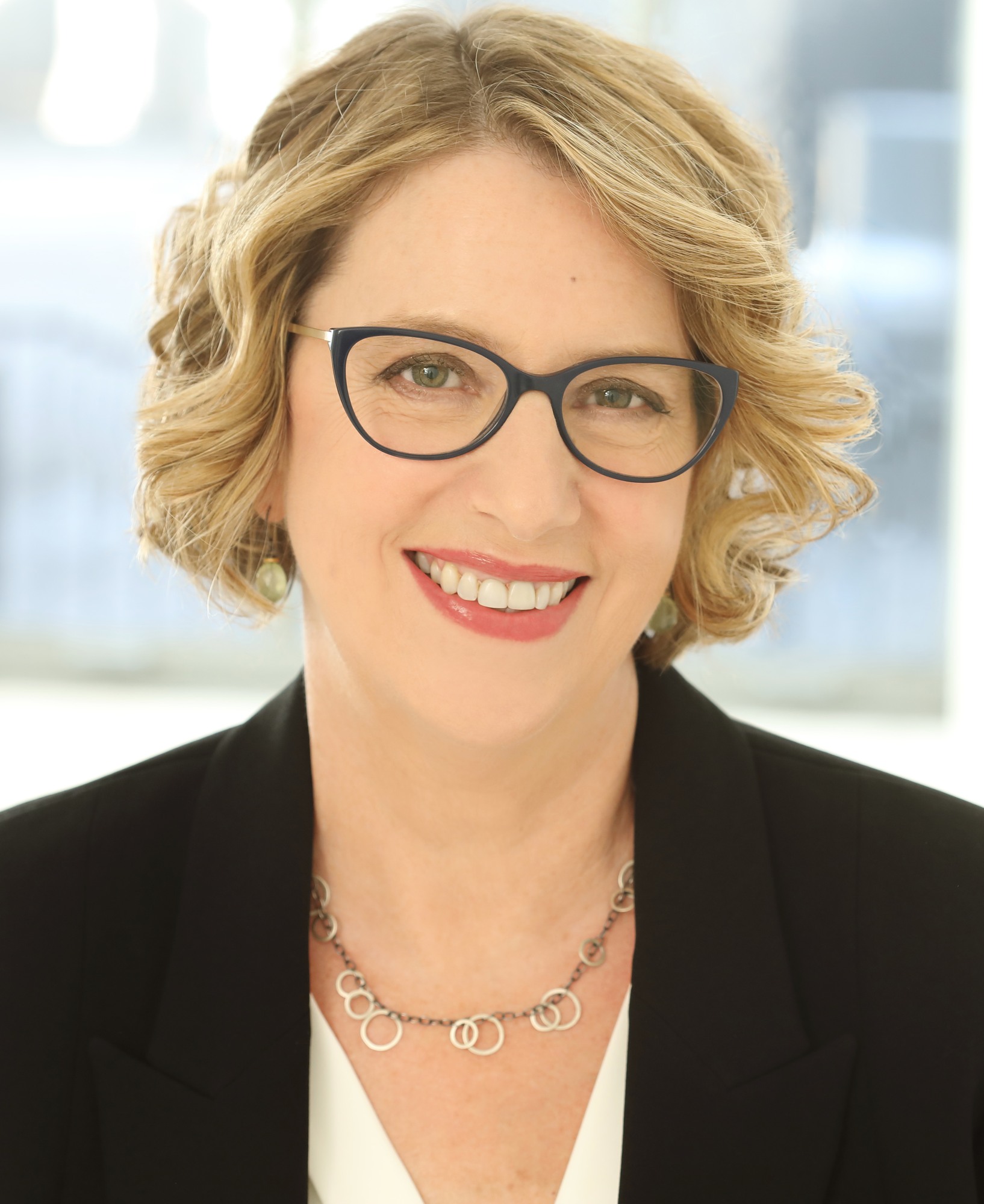
Amanda Anderson
Amanda Anderson, Andrew W. Mellon Professor of English and Humanities

From the Outgoing Director

We are living through a deeply unsettling time, marked by a number of heightened challenges. Central among these are the ongoing climate crisis, threats to democracy at home and abroad, and the accelerating incorporation of artificial intelligence throughout multiple sectors of society, including higher education. These challenges cannot be separated from one another, and they have a particular relevance for the humanities, which will be called upon to play a critical role in the coming years — in representing the distinctiveness of the human in relation to technology, the importance of value pluralism to democracy, and the responsibility of humanity to planetary well-being.

Given the difficulties we face, and the impact of the tragic events on campus this past December, the Cogut Institute this year joined many other units and colleagues at Brown in devoting its energies to community-centered intellectual life and programming attuned to the moment. Our faculty and students responded with marked engagement and presence at the institute, advancing our mission through collective inquiry and pedagogical innovation.
Continue reading

Look Back at More Than a Decade of Growth

Under Amanda Anderson’s directorship (2015–2026), the Cogut Institute has transformed the work of scholars across campus. Learn more through a video interview and a retrospective of some of the institute’s biggest achievements.

Cultivating Communities of Research

Investigating the Impact of AI Across Fields of Study

The Collaborative Humanities Lab “Models-Scale-Context: AI and the Humanities,” led by Holly Case (History) and Suresh Venkatasubramanian (Computer Science, Data Science), completed a second year of intensive collaborative activity. Symposia and workshops assembled experts in and beyond academia to discuss AI and its ramifications in politics, business, knowledge production, decision-making, and religion. Author Meghan O’Gieblyn, who had spoken previously at the institute about the meteoric rise of AI, returned for a lecture about the ways in which AI threatens attention and the critical importance of attention to human agency.

Holly Case led the graduate seminar “From Big Data to Lilliputians: Considerations of Scale Across the Disciplines,” and a new round of reading groups proposed by faculty and students across campus explored topics such as automation, the use of AI in literacy education, and generative AI in the arts. Courses and reading groups have proved to be a meaningful method of encouraging scholars with different levels of familiarity with AI to join focused conversations about AI.

Community Interview


Faculty and students reflect on how the lab impacts their research and thinking and how it underscores the critical role of the humanities.

Thinking Critically About Ethnic Studies and Its Future

Humanities Initiative Scholar, and incoming Cogut Institute Director, Shelley Lee (American Studies, History) launched “Origins and Afterlives of Ethnic Studies,” a project exploring Ethnic Studies as a grassroots academic movement that emerged in response to pressing social and political needs and has subsequently shaped thinking in and outside the academy.

The initiative’s inaugural event brought scholar and filmmaker Celine Parreñas Shimizu (Theater, Film, and Television | University of California, Los Angeles) to campus for a talk exploring Asian American representations in the media, challenges to academic freedom, and the importance of free expression in general.

As part of the initiative, Lee has launched a podcast, “The Confluence: Ethnic Studies and the Public Good” with cohost Gina Pérez (Comparative American Studies | Oberlin College). Lee and Pérez explore the meaning of Ethnic Studies in a democratic society, engaging guests about their work as educators, museum curators, and public intellectuals.

Facilitating Individual Research and Learning

The Fellows Seminar

The Fellows Seminar gathers scholars at all levels across disciplines in the humanities and the humanistic social sciences to pursue individual research projects and share their work-in-progress in a workshop setting. Scholars learn from the distinctive methods, modes of thought, and vocabularies of other disciplines; gain insight into the particularities of their own disciplines; and develop invaluable ways of communicating their work to a broad audience.

This year's fellows explored projects on topics such as provincial identity in the Roman Empire, the philosophy of AI, the politics of Holocaust memory, and the aspirations of universal humanism.

Watch short videos of all the fellows introducing their work

Fellow Spotlight


Undergraduate Fellow Camille Blanco, a concentrator in Classics and History of Art and Architecture, introduces her work on Roman provincial identity.

Engaging Students Across Campus in Shared Inquiry

A total of 37 courses, most of them new, brought recent and ongoing humanities research to the classroom.

In the collaborative humanities, Nadje Al-Ali (Anthropology, Middle East Studies) and Lingzhen Wang (East Asian Studies) designed a new undergraduate course on “Transnational Feminist Knowledge Production and Practices: Perspectives from East and West Asia.” The graduate seminars spanned the fields of archeology, comparative literature, history of art, and modern culture and media, among others.

Digital Humanities Librarian Tarika Sankar, concurrently appointed as a lecturer in humanities, launched “Decolonizing Data: Approaches from Caribbean Digital Humanities and Beyond,” and Linford Fisher (History), as interim faculty director of the Library’s Center for Digital Scholarship, taught the annually evolving “Introduction to Digital Humanities.” Postdoctoral research associates Cherod Johnson and Eda Tarak enriched Brown’s environmental humanities portfolio with four new courses.

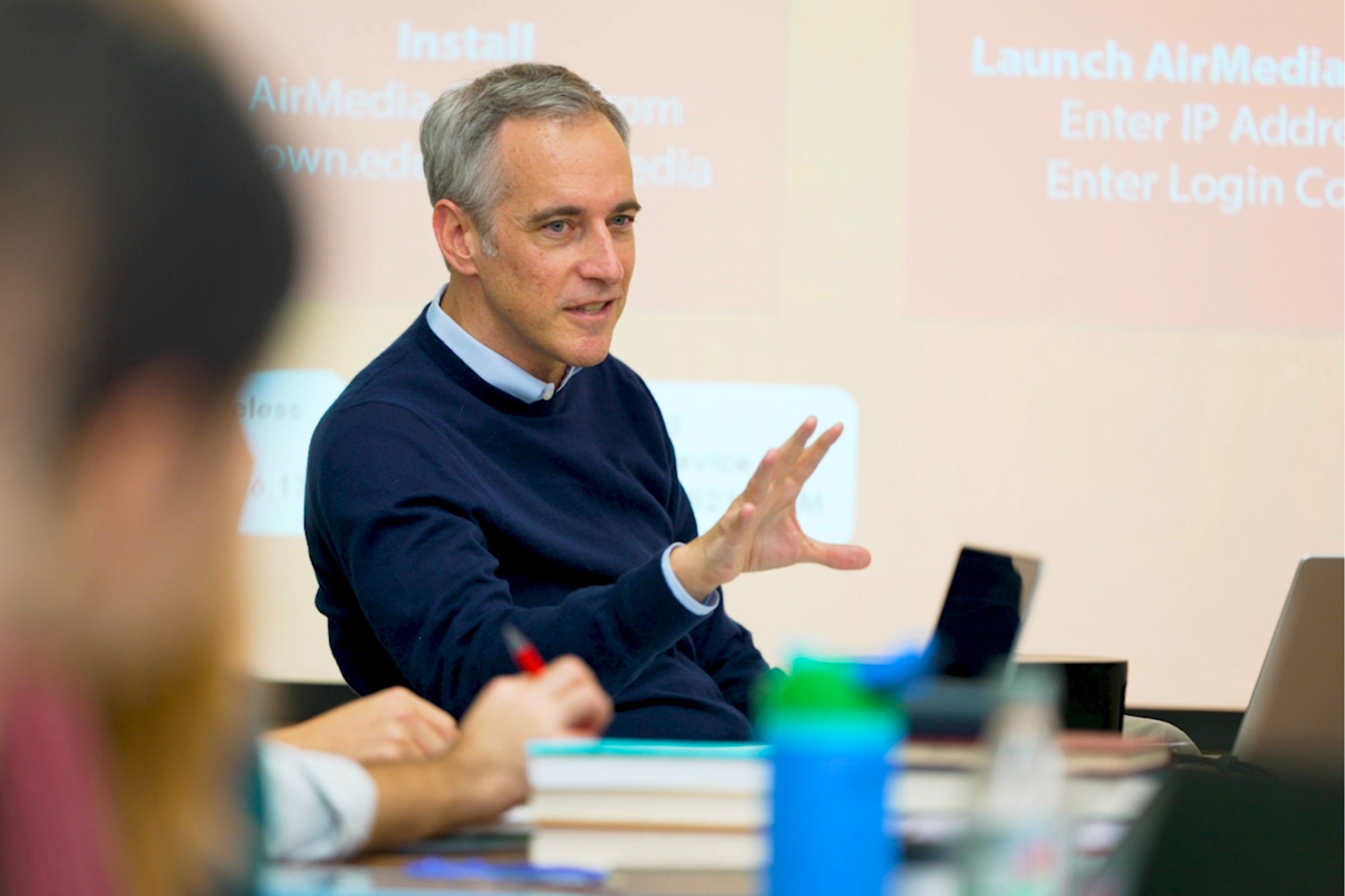
Jeffrey Moser leading a course dicussion.

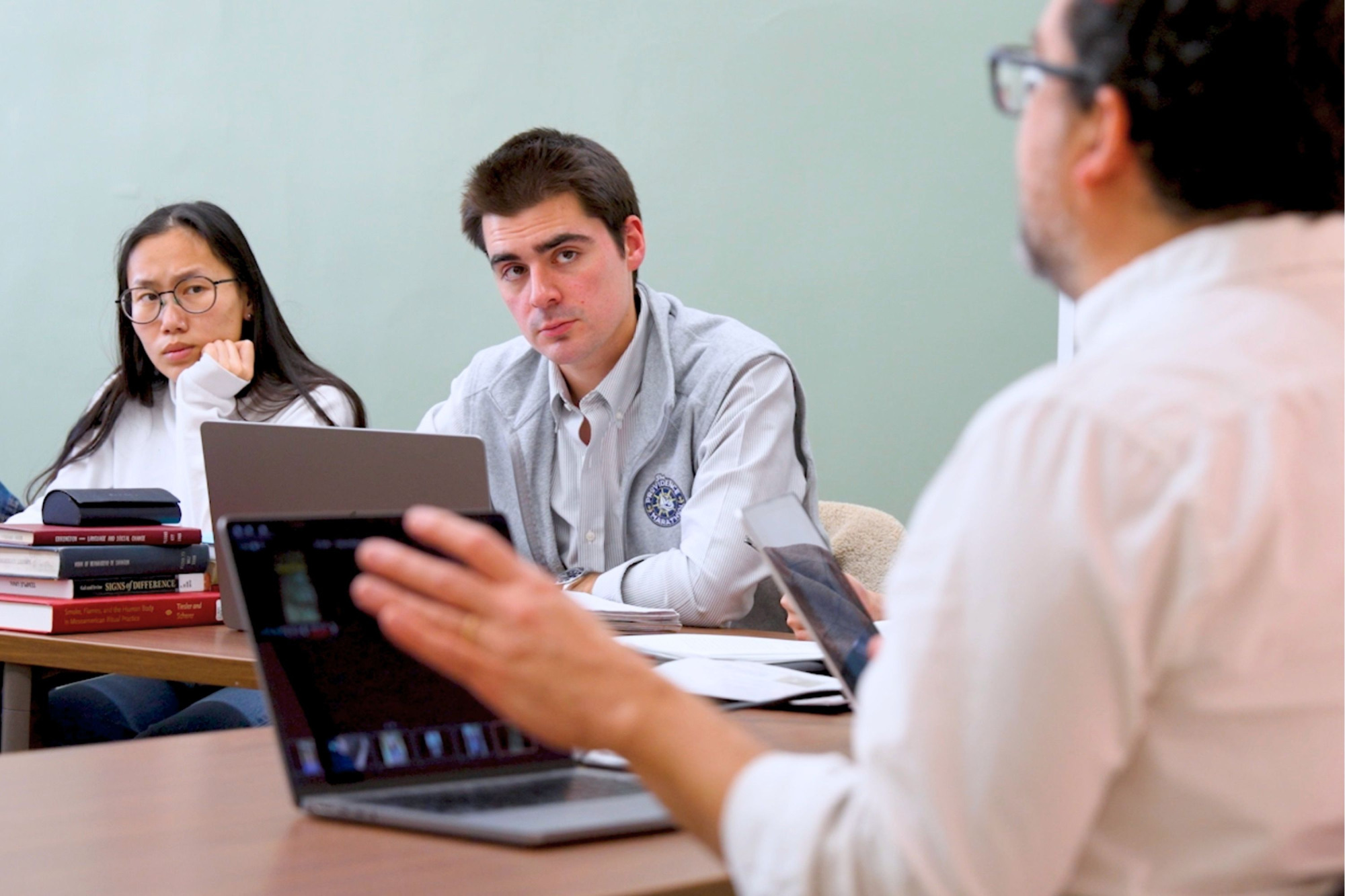
Students listening to Felipe Rojas Silva lead a discussion.

The course “Race and Its Avatars: Literary Identity Politics from the Medieval to the Present,” led by Daniel Kim (English, American Studies) and Mariah Min (English) produced a conference featuring their graduate students and a keynote by scholar Leerom Medovoi (Religious Studies | University of Arizona). The course and conference explored pre-modern forms of collective hatred and fear that emerged prior to the stabilization of race as an identity marker.

2025–26 Course Catalog

“ This course brought together many scholars from different fields . . . Our different ways of approaching ideas and tackling problems was often a topic of discussion along with our weekly readings, allowing me to think more critically about what it looks like to conduct interdisciplinary scholarship within the humanities. I often felt like all of us took turns teaching and being taught. ”

Graduate Student on the course “From Big Data to Lilliputians: Considerations of Scale Across the Disciplines”

37

Courses in 2025–26

9

Collaborative Humanities Courses

22

Courses taught by faculty fellows and postdoctoral affiliates

18

Departments/units represented

Doctoral Certificate in Collaborative Humanities

Four doctoral students completed the doctoral certificate this past year: Jason Emmett Collins (English), Tessa Finley (Religious Studies), Michele Moghrabi (Comparative Literature), and Luvuyo Equiano Nyawose (Modern Culture and Media). The total number of graduates now comes to 78 in the program’s eighth year. Congratulations to all!

Doctoral certificate recipients

Engaging Scholars in Critical Dialogue

Greg and Julie Flynn Cogut Institute Speaker Series

The institute’s flagship series brings to campus high-profile speakers who have been nominated by faculty and undergraduates at Brown. Pulitzer Prize–winning author Jhumpa Lahiri discussed writing across languages; political theorist and civic leader Danielle Allen (Government, Education | Harvard University) spoke about collaboration for positive change; and celebrated environmental historian Sunil Amrith (History | Yale University) explored violence as a driving factor in our planetary crisis.

Jhumpa Lahiri talking and gesturing with her hands.

Sunil Amrith speaks from the podium.

Danielle Allen discussing with students in a seminar.

These speakers also held seminars for small groups of undergraduates with diverse interests. The attendees of Lahiri’s undergraduate seminar, for example, came from 14 different concentrations, including Applied Mathematics, Biology, International and Public Affairs, and Neuroscience.

“ It’s a very precious opportunity to discuss and study literature with a writer, translator, and scholar I deeply admire. ”

Undergraduate student attending Jhumpa Lahiri’s seminar

47

Programs Open to the Public in 2025–26

2,499

Attendees Around the World

35,800

Video Views on YouTube

The initiative experimented with a new debate format and hosted two events that filled our space to capacity. One considered the extent to which our current political moment is unprecedented; the other reflected on the limitations of Marxist thought.
The Disability Studies Working Group hosted two major events on premodern disability, including a daylong symposium and a talk by scholar Genevieve Love (English | Colorado College) on the relationship between disability and character in the works of Shakespeare and others.
The series featured screenings and discussions of two films from the past decade: the 2023 Japanese film “Evil Does Not Exist” [“Aku wa sonzai shinai”] by Ryūsuke Hamaguchi and “A Fantastic Woman” [“Una mujer fantástica”] by Sebastián Lelio.
The Humanities in the World initiative convened this special series inviting Brown Ph.D. graduates Suvaid Yaseen (Asian Studies | Hamilton College) and Arnav Adhikari (English | Mt. Holyoke College) back to campus for talks, respectively, on colonial legacies in Kashmir and the aesthetic strategies of realism in the context of historical emergencies in India.

Support the Humanities at Brown

Humanities research is essential to understanding the historical record, our cultural archives, ongoing and emergent trends, and the multiplicity of ways in which we relate to each other as people. It provides the foundation for envisioning and plotting a course to a positive future. At a time when misinformation and disconnection are on the rise throughout society, support of the humanities is deeply needed.

You can help Brown University continue to develop cutting-edge new research and world-class leaders by supporting the Cogut Institute. Your gift to the Cogut Institute will be an investment in resources and opportunities that attract talented new faculty to campus, enable students to realize their potential, and help scholars at all levels to shape critical conversations in the world today.

We have space-naming opportunities in Andrews House that will help us to expand our programming and teaching. A gift in support of the following priorities will also contribute to growing the humanities faculty, extending financial support to scholars, and enriching the student experience:

  • Humanities Initiative Professorships
  • Interdisciplinary centers and initiatives
  • Graduate student training and professionalization
  • Our essential Director’s Innovation Fund

To learn more about how your gift will make an impact, please contact Shelley Roth P’17, P’20, Director of Development for Academic Initiatives, at shelley_roth@brown.edu or (401) 863-6592.