The Importance of Stories in Medicine
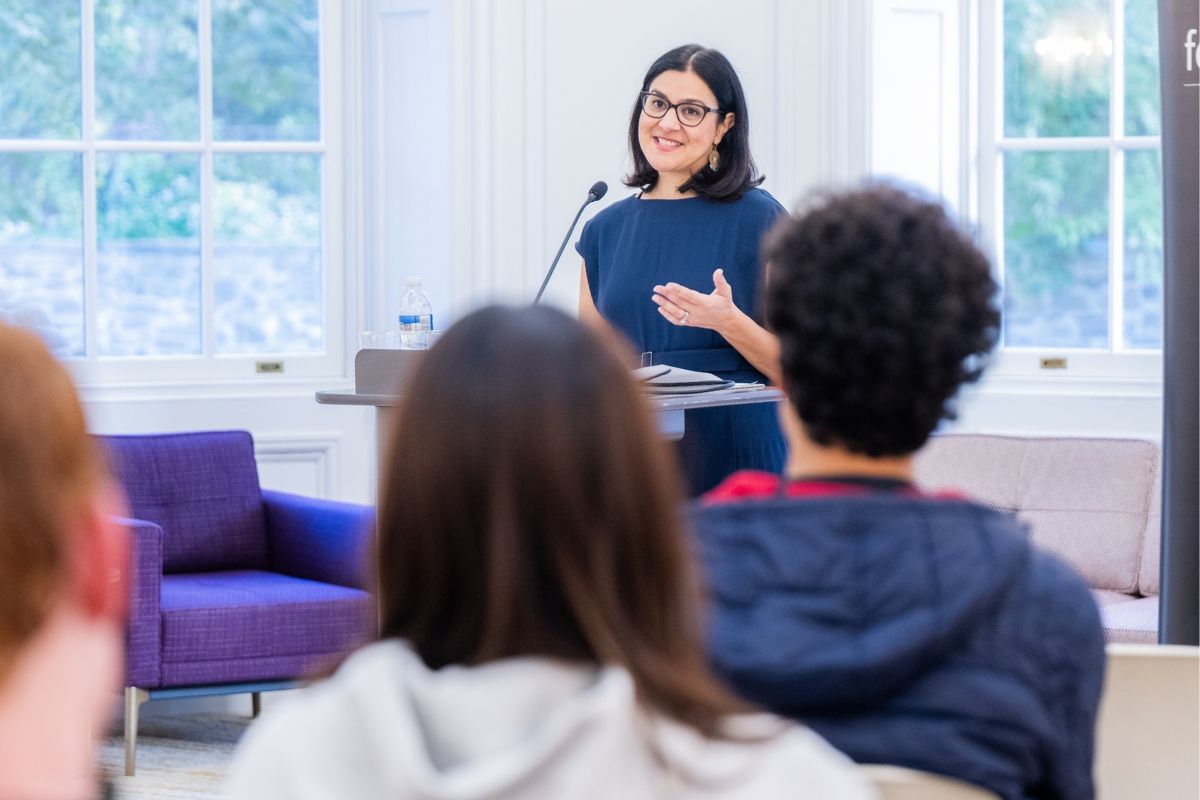
Gregory Kimbrell: You recently visited the Cogut Institute for the launch of the latest issue of The Brown Journal of Medical Humanities, and you gave a talk about how creative writing is a fundamentally hopeful act. People describe creative writing in all sorts of ways — some describe it in very important terms, as an act of understanding the human psyche or breaking through the veil of reality, while others describe it more in terms of entertainment, as a form of escapism. But thinking of creative writing in terms of hope is striking, and it’s energized my own work since hearing your talk.
Rachel Kowalsky: I’m so glad to hear that! My time at Brown as an undergraduate was right around when the musical Rent came out, and it was like the soundtrack to my life then. There’s this one line — “The opposite of war isn’t peace. It’s creation.” I think about that all the time. Creating something, writing something, is such a powerful act. It’s hopeful for a few different reasons. The first is that when you’re writing something for publication, as the contributors to The Brown Journal of Medical Humanities do, it presupposes a reader and a day. It says there’s going to be somebody to read this, and the day’s going to come when it’s in print. It’s like a message in a bottle.
The second thing is that when we write, we push back against forces that oppose us in life. Some of those forces could be abstract, like self-doubt, like “I’m not smart enough. I’m not bright enough. I’m not creative enough. I’m not a writer” — you hear so many people say that. We push back against those forces, and we declare ourselves: “No, I’m making my mark here. This is me. I was here.” Sometimes it feels a bit like being a graffiti artist: “I had this thought, and I’m putting it down.” It’s a little defiant.
There are other forces we push back against in order to get words onto the page. Sometimes it’s illness. Sometimes it’s grief. Sometimes it’s physical pain. Some people are writing while they’re hungry. Some people are writing in captivity. And so it really is a move of defiance — and hope, hope that we can push those forces back a little and see beyond them. There are also forces that look to discount the writer. Implicit bias is a big one. Hate is a big one. So you write despite knowing you may not be able to get published because of your last name or your race or your ethnicity. You might not find an audience for your work, because you’re meeting a biased audience. So you’re pushing back against those forces and saying, “In spite of these things, I’m going to tell you what I see.”
Gregory Kimbrell: That’s wonderful. I think part of what resonates with me is that there are so many things that could prevent us from sharing our story, from being creative, from being imaginative, it’s so easy to think, “My voice doesn’t matter. I’m not going to be heard. Why should I bother?“ You’re absolutely right that hope and defiance are in creative work. I like the inclusion of defiance in this picture. Creative work is powerful.
You just mentioned a number of medical realities that people are dealing with, and I remember you said that you approach medicine with your “humanities brain.” I love that idea, and I wonder if you could speak a little bit more about approaching medicine from a humanities perspective.
Rachel Kowalsky: I think, first of all, the world of the humanities is a world of story. Whether you’re talking about Sociology, Anthropology, Psychology — stories, by which I mean making meaning from events, are involved in every branch. This is particularly true of literature, which is the branch that I love. I was a Comparative Lit major. Professor Weinstein was my advisor. Literature, I think, has all the truths in it. It’s a record of everywhere we’ve been. It’s a record of all the human experiences, the emotions, and what I think of as the big themes: love and hate, anxiety and relief, guilt, redemption. All of that is recorded in perpetuity in these bodies of literature that we have from around the world, from our creation epics going forward. I feel like I have all of that as a repository and a way of understanding what I see in the emergency room.
For example, you see a frightened parent. Let’s say their child has a fever. But it’s a healthy child. They’re fully immunized, thank goodness; and they’re out of the vulnerable newborn period; the fever’s not very high; and everything points to the fact that the child is alright. They just have a cold. But the parent is terrified, and you’re having a hard time communicating that their child is safe. But if you have in your repository “Sleeping Beauty,” you can see that the parent is just waiting for that spindle. They know it’s out there somewhere, and it’s coming for their child. It’s coming for their kingdom, right? The child is the kingdom. And if you don’t recognize what a child means to a person and how threatening the world looks once you have something that precious, you’re missing the motivating force for many ER visits. But if you’ve read stories, you get it. You get it on the mythological level, the archetypal level. Another example is the concept of a good parent. If you’ve read Toni Morrison and understood what it is to parent in poverty, you can look much differently at questions of “good parents” and “bad parents” than if you haven’t read her work. It opens you up to what’s really happening for the humans that you’re interacting with.
Gregory Kimbrell: Right. And if your humanities brain is affecting your approach to medicine, then are there ways in which your being a doctor affects your approach to creative writing? I mean, certainly thematically, but beyond that...
Rachel Kowalsky: Well, I’m always writing about medicine even when I’m not writing about hospitals and care spaces, because I’m writing about personhood. My characters have anxieties; they have fears; they have desires. When you write about human turmoil, you’re writing about medicine. And working in the ER is a real lesson in what humanity is all about. Outside of the ER, we have all these niceties, conventions that soften interactions. There’s so much small talk that fits into all these spaces in life. But in the ER, you’re seeing the absolute truth, everything you suspected was there but nobody really says out loud. And then you’re like, “This is actually what’s happening just a few inches below the surface.” You get to see — you’re privileged to see — real grief, real fear, real anger, in context. You’re right there in the room while kids are hashing out their identity with a parent who doesn’t get it. You’re right there for conversations that otherwise you’ll see once or twice in a lifetime. So it’s this concentrated dose of humanity. And I think that helps me with my writing. Now, when I reach for an image of grief, I know the body language. I know what someone’s voice sounds like. I know what it might sound like when it’s mixed with guilt or when it’s mixed with anger. You really see a lot up close.
Gregory Kimbrell: People talk about medicine as a high-stakes field, and it is. Similarly, people talk about creative writing sometimes as a thing that the world doesn’t really need. It’s frivolous. It’s fantasy. It’s all made up. And yet people also talk about what the writer owes to their characters, and writers will often talk about feeling great affection for the characters that they’ve created. And sometimes, even apart from the whole architecture of publishing and making money from writing, writers will return to the same characters over and over again and talk about how there’s more to the story that needed to be told. What is your relationship to the characters that you create?
Rachel Kowalsky: That’s a great question. The stakes in creating, in faithfully creating, a character kind of feel the same as they are in faithfully representing another person in medicine. When we describe patients to consultants or in the medical record or to one another on the team, getting it right is really important, because, again, it reflects respect for personhood. And when you create a character, it’s a kind of moral act, because you’re going to imbue them with certain characteristics, and then things are going to happen to them, and that’s going to tell us a moral story. The mean character won’t find love, and so forth.
I also think this gets into the “Who can write what?” question. Can a woman write a man? Can someone from the suburbs write somebody from the city? And then of course it goes deeper. I’m Guatemalan, so can I write all the Guatemalans? There are 22 Mayan Indigenous groups. Can I write any of them? I did once write a Kaqchikel character. I did an enormous amount of research to be faithful to that character. I interviewed people from the actual village where the character was from and had several Kaqchikel readers review the manuscript. It made me so nervous. The story was called “The Delivery Boy” — it took me years to write — and there’s a character named Brittany Brathwaite who’s from Guyana. I wanted to tell part of the story from her point of view, in the first person. The story is told by multiple storytellers. One is Mexican. One is Indigenous Guatemalan. One is a white guy from New York. And there’s Brittany Brathwaite. And I found that no matter how much research I did, she wasn’t letting me in. She was like, “I’m not first person for you.” I did interviews. I ordered Guyanese cookbooks and histories. I got deep into the research, but ultimately I said, “I can’t get in. And so I won’t try. She’s telling me it’s not my place.” So, yes, there’s a lot at stake when you create a character.
Gregory Kimbrell: I’ve heard people say that there’s a sort of bravery implicit in attempting a perspective that isn’t your own and that it’s better to try and fail than not to try at all. What are your thoughts on that?
Rachel Kowalsky: I think that we should be able to be curious about other people, and as long as it’s a warm curiosity and not a skeptical or holier-than-thou curiosity, it’s a wonderful impulse. There’s this lovely passage from the novel Tomorrow, and Tomorrow, and Tomorrow by Gabrielle Zevin where cultural appropriation is being discussed. Sam Mazer, one of the protagonists, says:
The alternative to appropriation is a world where white European people make art about white European people, with only white European references in it. Swap African or Asian or Latin or whatever culture you want for European. A world where everyone is blind and deaf to any culture or experience that is not their own. I hate that world, don’t you? I’m terrified of that world. I don’t want to live in that world.
As Mazer says, “I don’t want to live in that world.“ I want to be able to be curious about other people and imagine them and see if I can inhabit their perspectives. That’s where I land. And I won’t always be successful, so I won’t always write those characters. But I’ll totally try. I do wonder where the boundaries are. I think about that question a lot. What can I write? But I think we have to try. I think that’s part of understanding other people. What is life for them? What do they see? What do they think? What do they feel?
Enriching Medical Practice — The Health Humanities
Gregory Kimbrell: Would you say a little about the health humanities, and what do you want the people who participate in your classes and workshops to take from them?
Rachel Kowalsky: The health humanities connect the humanities to patient care, to professional development, and to the wellbeing of communities. That’s the definition that I use for my students. The health humanities benefit medical practitioners in terms of both clinical skills and professional identity development and ultimately help us to take better care of people and communities.
Among the clinical skills that the health humanities support, first there’s “close looking.” For example, we carefully observe patients to notice subtle physical findings or to hone in on emotions they might be feeling.
Then there’s careful listening — learning not to interrupt people and letting them tell you their story before interjecting with questions; resisting the temptation to shape the narrative to your own ideas about the world.
Next, the health humanities help us develop a greater facility with story. This is important in the emergency department — understanding how stories work, that stories are told from particular points of view and in certain emotional contexts. An ER story is often filled with emotion. Anxiety is the biggest one. Pain is another. It’s critical to understand how to receive a story told through emotions like anxiety or pain, because it’s not always told in a linear way or in a way that makes perfect sense to you right away. There might be gaps. There might be things that internally contradict, that you simply have to go with and return to later.
Similarly, facility with social and historic narratives is important. Think about, for example, pulmonary function testing in the U.S. Pulmonary function tests — measurements of air flow through a person’s lungs — are important for diagnosing conditions like asthma or COPD. But the reference value norms, the standards that a given patient’s test results are judged against, were originally racialized. In other words, there were different standardized normal values for someone who’s Black, for someone who’s Hispanic, and for someone who’s white. And so what the health humanities does — and Brown University Professor Lundy Braun was foundational here — is ask, “How did this happen? Why are these reference values racialized?” The humanities go back through history to figure it out so it can be undone. Thanks in part to Dr. Braun’s work, the American Thoracic Society made an official statement in 2023 recommending race-neutral interpretation of lung function. But you still have to be aware of that narrative, and that there are others out there. There are narratives about child abuse, about gender identity, about ethnicity and pain thresholds, that are disproven, but still inform research design and the interpretation of research data. They’re false, but they’ve become woven into current thinking and practice. And you have to be able to recognize them and call them out.
Next, the health humanities can support a clinician’s capacity for empathy. That’s kind of what we’re talking about when we’re talking about creating characters when you haven’t experienced lives like theirs firsthand. Familiarity with many stories across many traditions can help close the gap, both when writing fiction and when caring for a patient in the ER. For example, let’s say you’ve never lost a child, but you’ve read Don Paterson’s “A Threshold,” or you’ve read Yamanoe Okura’s “Elegy on the Death of Furuhi.” So you at least know the themes. You know what’s at stake. You know what emotions might be there. You never know exactly what they are for the individual, but you have some sense of the landscape before you take care of that family.
Comfort with uncertainty is another clinical skill supported by the arts and humanities. In the ER, we’re often uncertain. We’ve often got half the story, sometimes less. Your patient might come in unresponsive, intoxicated, or in too much pain to tell you what happened, so you have to become comfortable in that milieu. Most clinicians don’t like uncertainty. It makes it difficult to pinpoint diagnoses and plan therapy. But many artists see questions as opportunities to think and mull and create, rather than as problems. Approaching questions in that way helps medical professionals too. It helps us stay open to multiple possibilities, multiple interpretations of events, and to feel more at ease when we don’t have all the facts of a case.
Lastly, there’s the professional identity development component. The arts and humanities provide space and time for students and residents to reflect on their experiences, and we think this helps process events that take place on a shift or during a rotation. It allows students and residents to think about the ways in which their experiences are changing them, if the change is positive, and which clinicians they hope to emulate or not.
In short, there are so many ways the humanities and medicine can productively overlap. I think they’re two sides of the same coin.
Gregory Kimbrell: I want to come back to the idea of community. One reads news pieces about doctors as an extremely vulnerable population and the isolating factors of the work and long hours, stress, and so forth, and the importance of connecting with people and honestly sharing your stories. And community is important not just among doctors, but among the patients themselves and their family members. It sounds like community is baked into your practice of the health humanities.
Rachel Kowalsky: I think the arts lend themselves to building community, because there’s an audience inferred in the art-making, and also because the people who create art often spend time together in their process. For example, I’m part of a writing group. We all met in a short story class at the Hudson Valley Writers Center, and now we get together on our own to workshop each other’s pieces. Finding people to be creative with has been amazing. They get you. They get why you would spend a whole day looking for just the right word for “underneath.” There aren’t many people in the world who will do that with you, and when you find them, it’s great.
And in medicine, it’s so important because medicine attracts these big-hearted people, and then it does not reward being big-hearted at all. It really flattens you. This relates to what you were saying about isolation, especially during training. You work weekends, holidays, nights. All the times when people are typically getting together to be social, you’re going to work. And a lot of that is during your 20s and 30s when it would be really fun to go out with your friends. And even when you get older — we have two kids, and to be driving away from them on Thanksgiving or New Year’s Eve or just a regular Saturday when they have a soccer game, that never gets easier.
So yes, it’s important to create community. At Cornell, we have a magazine similar to The Brown Journal of Medical Humanities. It’s called Hummingbird, and it creates community naturally during the process of putting it together. We also have humanities-related events, many planned by the students. Last year we did a figure drawing workshop, and we also had poet Joanie MacKowski from the Ithaca campus come do a workshop. We have a speaker series. This brings people together in such a lovely way. And you get to see who around you is artsy that you never would have guessed.
Gregory Kimbrell: What do you find most rewarding about your work as a creative writer and your work as a physician?
Curiosity and Delight — The Writing Process
Rachel Kowalsky: I’m a really curious person. I love exploring ideas and learning about other people. I have Rent on the brain. The song “What You Own” has a line about “Connection in an isolating age.” In the ER, you connect with other people. You meet families that you would never meet in any other way, and you see so many different ways that a family can look, different constellations of people with children at their center, and from all over the world, with many different perspectives on healthcare. To me that is fascinating. It’s so rich to see what other humans are like.
And then to work it out on the page — “What would happen if...” right? I wrote a story called “God’s Green Earth,” about a man who owns a deli, and he’s really anxious. He’s afraid to ride the subways in New York City because they’re so deep underground. And then I was like, “What would happen if he fell in love, and his love interest lived at the end of the deepest, most terrifying subway line? What do you do when on the other side of that anxiety is the thing you want the most?” That question could occupy me for days.
Gregory Kimbrell: When you do start writing a piece of creative writing, what sorts of things trigger your process? And do you plan a story in advance to a significant degree, or do you discover things as you go along? Or does that depend on the particular story?
Rachel Kowalsky: I usually start with an image or a line. For “God’s Green Earth” — what started that one was an image from a children’s movie, The NeverEnding Story. At the end of the movie, the princess holds a grain of sand in her hands, and that’s all that’s left of her world. In my mind, that grain of sand became a plum. And from there it went out to fruit, and from there it went to a New York City deli. Some images are like that. They stick in my mind, and I grow stories around them.
Plot comes last. I’ll know the story elements, the themes and characters, for a long time before I can answer the question, “What happens to these people? What if I put them all on a stage together?” It takes a long time for the plot to emerge, and I’ll change it in different iterations of the story as I continually say, “What if it happens this way? What if it happens that way?”
Gregory Kimbrell: Do you have a favorite part of the writing process?
Rachel Kowalsky: The early part, where it’s like your flow state, where you’re just riffing. I’ll feel charged up when I get an idea that I know is going to lead somewhere. It might not end up in the final product, but it might be good enough that it’s at least a portal. And that could happen walking my dogs or driving home from work. Sometimes I pull over on the Major Deagan on my way home, to make a note in my phone, because I want to capture an idea before I lose it. I love that.
Gregory Kimbrell: I love this notion of delight — especially in the context of the realities of medicine. It seems that delight is something that you absolutely take in your work, and it’s not always how people describe the writing process. There’s the archetype of the tortured novelist.
Rachel Kowalsky: Yes, I know. I think it’s because writing has always been like dessert for me. It’s something I often can’t quite get to because I’m working or doing something mundane, like laundry. Writing is this delicious treat that if I can get to it, that’s a good day. I think the tortured part, for me, is when I can’t get to the page. I write on Mondays, and if I can’t get to the page on a particular Monday, if something gets in the way, I get so upset. That’s the tortured part.
Gregory Kimbrell: Do you have particular pieces of writing that you look back on and think, “I’d like to revisit this,” or, “This needs a sequel, a second chapter, a redo.” Or do you think of your stories as self-contained and finished, and you move on?
Rachel Kowalsky: I think I could go in and edit any of my stories, because you’re constantly changing. You’re never the same person from one day to the next, because experiences change you. And then you come back to the page and you’re like, “Hmm, I don’t think I really understood this concept when I wrote this story. Now I could do a better job.” There are stories I could go back to. There are also things I would cut, that I’m like, “You know, I didn’t need to go on for so long about this. We get it.”
Gregory Kimbrell: But you resist the impulse?
Rachel Kowalsky: We joke about this in my writing group. Once a story is published, you can stop thinking about it. You’re like, “It’s done. It’s in its final form.” So that lets me resist the impulse. Until something’s published, I’m constantly going in and revising.
Gregory Kimbrell: And whenever you feel stuck or in need of inspiration, are there particular books or movies, pieces of music, etc. that you return to that either suggest images or help you to focus on the process or simply remind you of the fun that is to be had in creation?
Rachel Kowalsky: I subscribe to Poem-a-Day. There’s often inspiration there. I also read the short story in The New Yorker whenever I can. And I listen to the Poetry Foundation podcast. I have creative material coming at me constantly. But then my favorite conversation partners in my mind are Ocean Vuong, Toni Morrison, Mary Oliver, Ada Limón. Those are writers who I could reread — I mean, I must have read The Bluest Eye five times. There are some things I just read over and over — Beloved. I’ll never understand how Toni Morrison wrote that story. It’s so powerful, so viscerally felt. Toni Morrison I read over and over.
Gregory Kimbrell: And is there a particular project that you’re working on now that you’re excited about?
Rachel Kowalsky: Yes. I’m finishing a short story collection. I thought it was done, but the word count isn’t quite enough. I’m working on one story that I think will be called “Ahmed’s Daughter,” that takes place in the hospital gift shop. I love writing about different spaces in the hospital — the supply closets, all the little nooks and crannies.
Gregory Kimbrell: I love what you said about being fascinated by all of the spaces in the hospital.
Rachel Kowalsky: Oh my gosh. The trauma bay — I wrote about it in a story called “Burn.” These spaces are magical. There’s so much potential energy in the empty room, the medical instruments on the walls, the empty cot. The ambulance bay is full of expectation. Even the ICU — that’s a beautiful place. When we bring patients up there from the ER, it represents this very organized, tranquil — it’s like a rescue. You bring your patient up there, and immediately you hear the nurse snap the sheet as he or she makes the bed, and you know that’s the bed where your patient will literally be tucked in. And you hear the machines. There’s something about it that’s very reassuring and therapeutic and calming. After the chaos of a resuscitation in the ER, to walk through those doors and be greeted by all these very calm, skillful people, it’s a good moment.
Gregory Kimbrell: It reminds me of what people have said before about the creative potential in spaces such as airports and hotels, and how there’s this whole infrastructure around moving people from place to place or providing comfort, and yet nobody lives there. They’re these completely artificial, human-created worlds that exist outside the rules of normal life.
Rachel Kowalsky: A train station.
Gregory Kimbrell: Absolutely. Train stations make a wonderful setting for a story. Well, this has been a pleasure and an inspiration. I’m planning to write later and am looking forward to it. Thanks so much for taking the time to talk with me.
Rachel Kowalsky: Thanks for inviting me. I’m so glad you’re going to have a creative day.