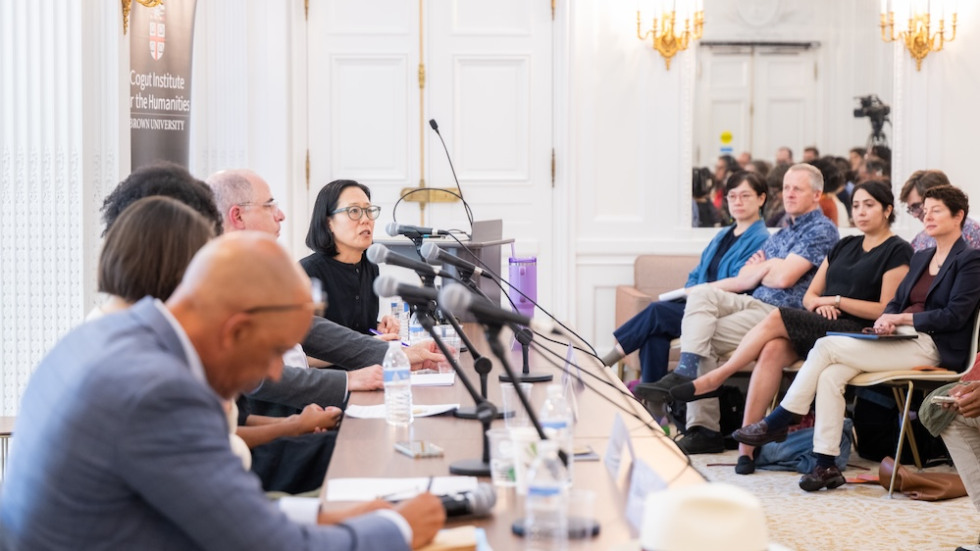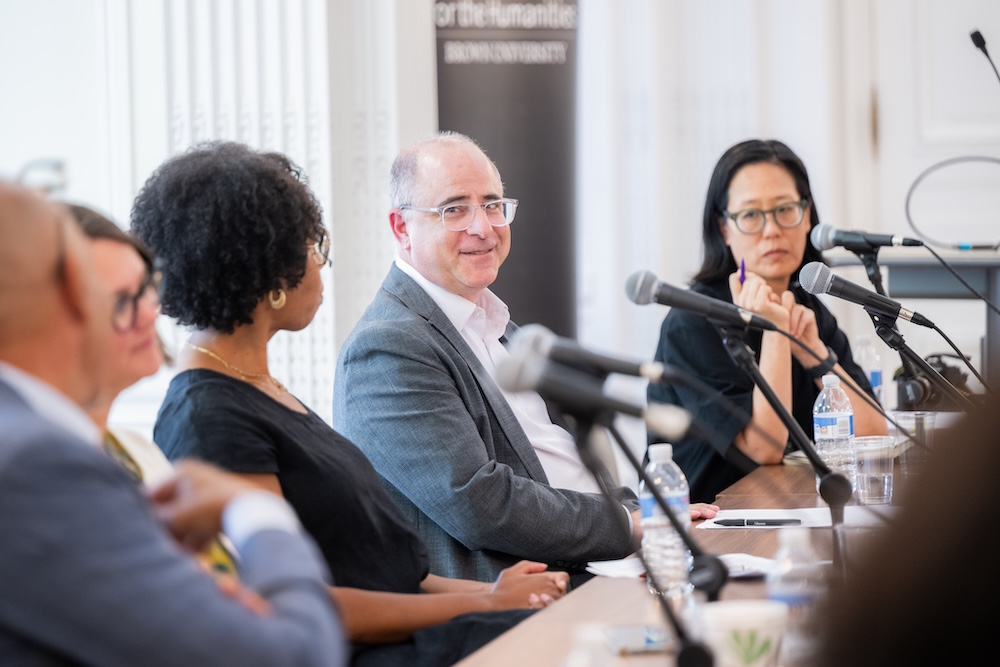
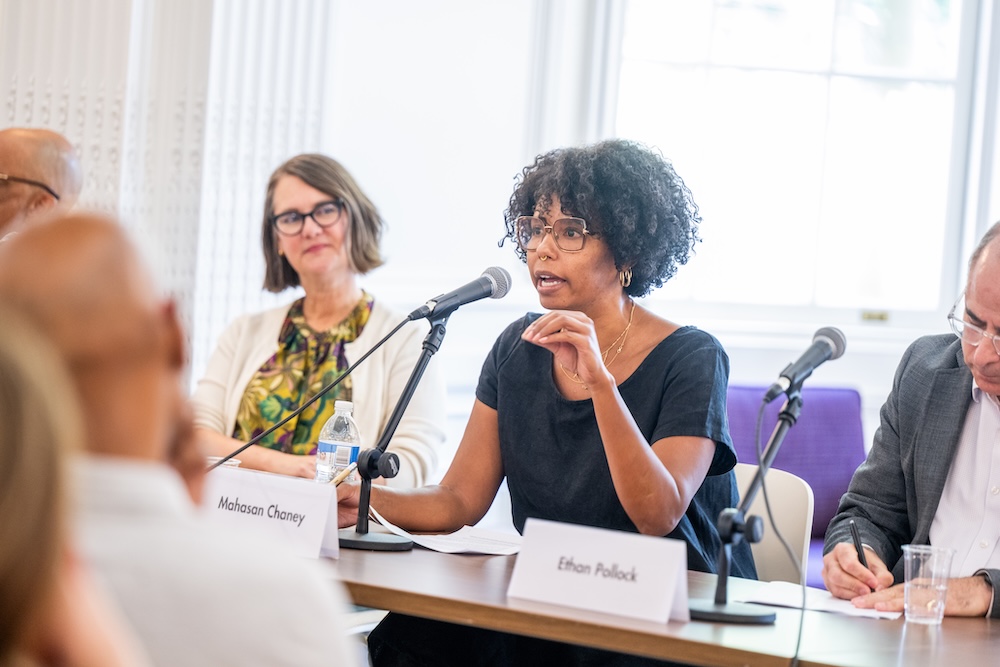
On September 11, 2026, the Cogut Institute launched “Humanists on ____,” a series of informal conversations that illuminate what the humanities and humanistic social sciences bring to pressing questions in our contemporary life and enduring preoccupations of human experience. The first installment, “Humanists on Education,” gathered Mahasan Chaney (Education), Tara Nummedal (History), Andre Willis (Religious Studies), and Dean of the College Ethan Pollock (History, Slavic Studies). During a turbulent moment in higher education and the start of a new academic year, the speakers brought an inquisitiveness, depth, and generosity that captured why Brown has some of our most dynamic and needed voices in the academic humanities today.
Upon noting the sole-authored monograph as the default mode of production and achievement in the humanities, Ethan Pollock wondered if and how the collaborative and collective aspects of our scholarship can be made more visible. “Is there a way we can give this collective more credit in our work?” he asked. In engaging with the question, other panelists spoke to how individual mastery need not eclipse collective effort. Indeed, each makes the other possible. Andre Willis asserted that “mastery demands solitude,” adding that it is a solitude sustained by colleagues, and that the work it produces is “informed by a collective.” On expertise, Tara Nummedal said that “becoming a historian is to learn to do things a certain way, and that matters too,” even as she spoke of new forms for “the learning that we do together.”
A sign of a successful event is the conversations it inspires afterward, and I found myself having many, particularly on the theme of community. They surfaced how we rely on others to become specialists and do our work; and we desire and need community; but we also face obstacles to making and seeing those connections. Conversations and collaborations with Senior Associate Dean Zachary Sng gave shape to this entire essay as did exchanges with Gregory Kimbrell and Emma Chung Trone, whom I name here in the spirit of Pollock’s query.
Widening the frame allows us to see how the interdependence of the individual and collective also runs through our teaching, and at Brown, it bears a distinctive imprint and legacy. In the late 1960s, the headwinds of antiwar activism, social movements, and rebellion against conformity converged on college campuses where entrenched authorities and traditions were challenged. At Brown, a student-led report on undergraduate education eventually led to the establishment of the Open Curriculum in 1969, which formalized the idea that students, empowered through their relationships with teachers and classmates, should be the “architects of their own education.” An education built on the belief that individual freedom is an engine of social responsibility and public good was possible because of collective action.
The freedom the Open Curriculum celebrates and affords endures, but the world around us has changed. Our culture today is a hyperindividualistic one, where freedom easily becomes isolation and education gets treated as transactional and instrumental. When such thinking seeps into the academic humanities — among students and scholars alike — the stakes are especially troubling. Ideas take shape slowly and iteratively, in seminars, at the proverbial water cooler, in a colleague’s comments on a draft, in dialogue with what came before. The profession, moreover, has its own obstacles, including tenure and promotion systems that reward individual achievement, the shrinking of opportunities that turn peers into rivals, and overpacked schedules that make time an ever scarce resource.
In this culture that measures education by earnings and impact by “analytics,” the humanities face a striking paradox. Our challenges have been widely reported on, from department closures to AI-driven uncertainty to attacks from the federal government. In 2025, U.S. colleges awarded the fewest humanities bachelor’s degrees since 1991, nearly a third fewer than in 2012. Yet another study found that most people have a favorable view of the humanities. Indeed, the public appetite endures, seen recently in Christopher Nolan’s The Odyssey helping to push U.S. sales of Emily Wilson’s translation past a million copies. People still want what the humanities promise: a deeper and fuller understanding of the world, and meaningful connection to something larger than ourselves.
As to what we do as scholars and faculty in the face of this hunger and uncertainty, Mahasan Chaney cited a 1991 speech by Toni Morrison where the celebrated author described a feeling of vertigo because the humanities — then also under threat — seemed to be simultaneously at the center of civilization and at its periphery. Such a moment, Morrison said, brought a sense of adventure alongside a sense of being under siege. In turning this description into a question for us that day, Chaney opened a galvanizing space for reflection, where I have since remained: “What is the adventure of collective thinking together, knowing we are under siege?”